
Low vision
< Tornar a "Treatments"What is low vision?
Low vision is the visual condition experienced by a person with a significant reduction in their vision, which does not improve with proper correction using glasses, contact lenses, or even appropriate pharmacological treatments or surgery, and as a result, they encounter difficulty or inability to perform certain daily tasks.
There are many causes that lead to low vision, primarily eye diseases (Macular degeneration, Glaucoma, Diabetic retinopathy, Retinitis pigmentosa, High myopia, etc.), but also accidents, neurological injuries, congenital malformations, or infectious diseases, among others.
There is not just one way of seeing with low vision; rather, there can be various symptoms that produce it either individually or in combination. Some examples include blurred vision, patchy vision, glare, night blindness, tunnel vision, loss of contrast, or color vision alteration.
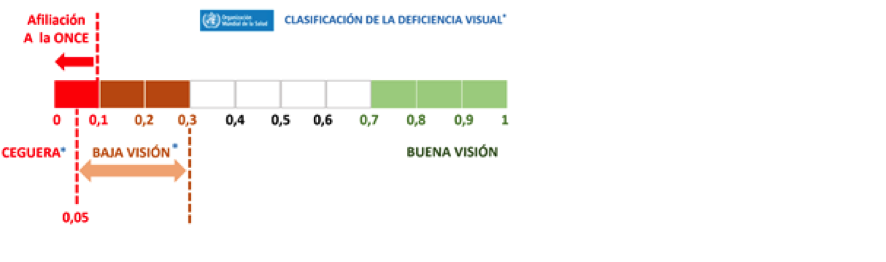
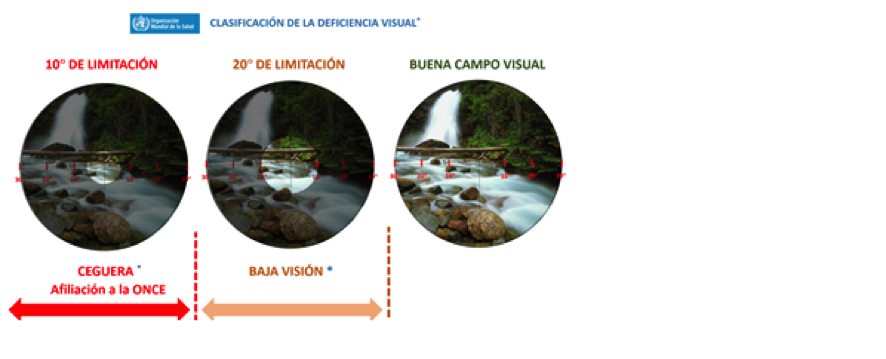
A patient is considered to have low vision when, after the best optical correction, their visual acuity is less than 0.3 in the better eye or a visual field of less than 20 degrees.
What does it mean to be legally blind?
For those unfamiliar with visual impairment, blindness means complete loss of vision. However, in Spain an individual is considered "legally blind" if they have a visual acuity of less than or equal to 10% and/or a visual field of less than or equal to 10 degrees in their better eye. This means that many legally blind individuals have some residual vision, but with significant limitations that vary greatly from case to case.
What is the difference between total blindness and legal blindness?
A person is considered totally blind if they have experienced a complete loss of vision or can only distinguish light from dark.
A person is considered legally blind when their visual acuity (with glasses or contact lenses, if needed) is ten times lower than normal in their best eye, or when their visual field, disregarding acuity, is restricted to an angle of 10 degrees or less.
Who might need low vision aids?
Patients with high myopia, macular degeneration AMD, optic nerve pathology, retinitis pigmentosa, diabetic retinopathy, cataracts, glaucoma, corneal pathologies, retinal detachment.
Low vision aids can therefore help all these patients who want to enhance their visual condition, be it in acuity, contrast, or visual field.